Table of Contents
ToggleIf you’ve noticed your water softener making odd sounds at 2 a.m., or you’re wondering why you can’t use the hot water at certain times, you’re probably hearing regeneration in action. This maintenance cycle is essential for keeping your system running efficiently, but it’s not exactly quiet or convenient. Understanding how long a water softener takes to regenerate, and when it happens, helps you plan around it and avoid surprises. Most regeneration cycles last between 60 and 120 minutes, depending on your system’s size and settings. Let’s break down what’s happening behind the scenes, how long the process actually takes, and what factors can speed it up or slow it down.
Key Takeaways
- Most water softener regeneration cycles take 60 to 120 minutes, with typical residential systems completing the process in 90 to 120 minutes depending on tank size and capacity.
- Water softener regeneration time is influenced by system size, water hardness levels, and whether your unit uses a fixed schedule or demand-initiated metering.
- Regeneration typically occurs between 2 a.m. and 4 a.m. to minimize household water usage and prevent interruptions during the recharge process.
- Using water during regeneration reduces the effectiveness of the cycle and can extend the time needed, so it’s best to avoid water use when your water softener is regenerating.
- You can adjust your water softener regeneration start time in the control head settings to match your household routine and avoid peak usage hours.
- Higher water hardness levels (above 10.5 gpg) trigger more frequent regeneration cycles and increase overall salt and water consumption.
What Happens During Water Softener Regeneration?
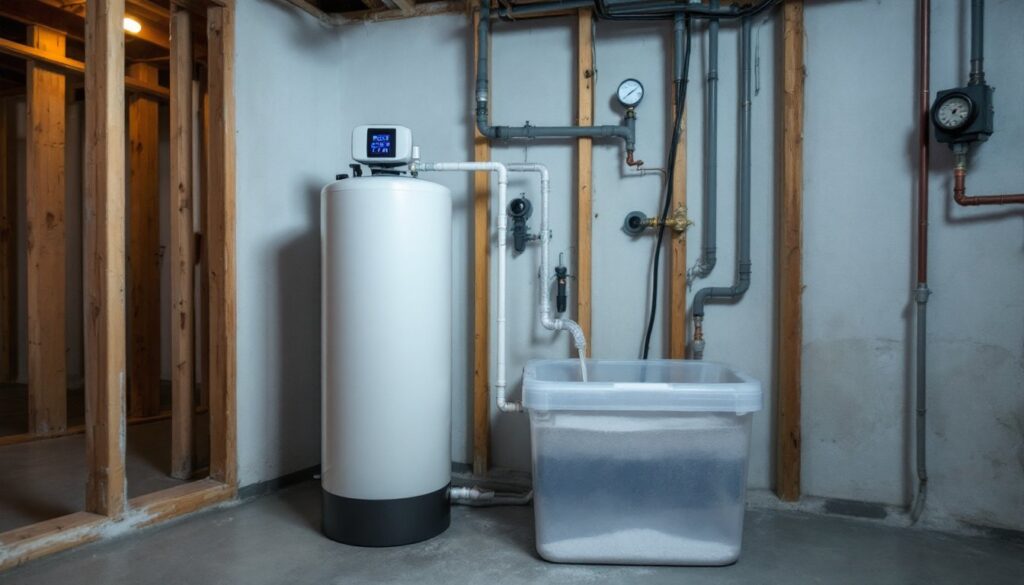
Water softener regeneration is the cleaning cycle that flushes out accumulated hardness minerals, primarily calcium and magnesium, from the resin beads inside the tank. Over time, these beads become saturated with minerals and lose their ability to soften water effectively.
During regeneration, the system pulls brine (a concentrated salt solution) from the brine tank and backwashes it through the resin bed. The sodium ions in the brine displace the trapped calcium and magnesium, essentially resetting the beads so they can resume softening. The wastewater, carrying the flushed minerals, exits through the drain line.
The process typically includes several distinct phases: backwash (flushing sediment and debris out of the tank), brine draw (pulling salt solution through the resin), slow rinse (pushing the brine through the bed), fast rinse (flushing out remaining brine and minerals), and refill (topping off the brine tank with fresh water). Each phase has a specific purpose, and skipping or rushing any of them can reduce the system’s efficiency or lifespan. If you’re troubleshooting issues with your water quality, understanding this sequence helps you pinpoint where the problem might be occurring.
How Long Does Water Softener Regeneration Take?
Most residential water softeners complete a full regeneration cycle in 90 to 120 minutes. But, compact or lower-capacity units may finish in as little as 60 minutes, while larger whole-house systems serving multiple bathrooms can run closer to 2 hours or slightly longer.
The cycle time depends largely on how your system is programmed. Older mechanical models and timer-based units often have fixed regeneration schedules that run the full sequence regardless of actual water usage. These tend to stick to a standard 90-minute window. Newer demand-initiated or metered systems monitor water consumption and regenerate only when necessary, but the cycle duration itself remains similar, it’s the frequency that changes, not the length.
If you’re asking how long it takes to recharge a water softener, you’re asking the same question. “Regeneration” and “recharge” are used interchangeably in the industry. Both refer to the salt-washing process that restores the resin’s softening capacity. So whether you see “regeneration time” or “recharge time” in your system’s manual, expect the same 60- to 120-minute range.
Some high-efficiency models from brands featured on home improvement platforms advertise shorter cycles by optimizing brine contact time and rinse phases, but they still need at least 45 to 60 minutes to complete a proper flush. If your system finishes much faster than that, it may not be fully regenerating, which can lead to hard water breakthrough.
Factors That Affect Regeneration Time
Not all regeneration cycles are created equal. Several variables influence how long the process takes and how often it needs to happen.
System Size and Capacity
Water softener capacity is measured in grains, the total amount of hardness minerals the resin can remove before needing regeneration. A 32,000-grain system will take longer to regenerate than a 24,000-grain unit because there’s more resin to flush and more brine to cycle through.
Larger tanks also require more backwash time to properly distribute water through the bed and lift out sediment. If you’ve got a 10-inch diameter tank versus a 12-inch, expect the bigger one to add 10 to 20 minutes to the cycle. Commercial or whole-house systems serving four or more bathrooms often include dual tanks or oversized resin beds, which can push regeneration closer to the 2-hour mark.
Capacity also dictates how frequently regeneration occurs. A household using 80 gallons per day with moderately hard water might regenerate every three to four days on a mid-sized system, while a larger family with very hard water could trigger it nightly.
Water Hardness Levels
The harder your water, the faster your resin saturates, and the more often you’ll regenerate. Water hardness is measured in grains per gallon (gpg) or parts per million (ppm). Moderately hard water falls between 3.5 and 7 gpg: anything above 10.5 gpg is considered very hard.
If your municipal supply or well water tests at 15 gpg, your system will exhaust its capacity much quicker than if you’re dealing with 5 gpg. That doesn’t necessarily make each individual cycle longer, but it does mean more frequent regenerations, and more salt and water consumption overall.
Some systems allow you to manually adjust hardness settings in the control valve. Setting it too low can cause premature regeneration and waste salt: setting it too high risks running out of capacity before the next cycle, letting hard water slip through. When installing or servicing a softener, it’s worth investing in a water hardness test kit to dial in the correct value. Many pros recommend testing annually, especially if you’re on well water, since mineral content can shift with seasonal water table changes.
When Does a Water Softener Regenerate?
Most water softeners regenerate in the middle of the night, typically between 2 a.m. and 4 a.m., when household water demand is lowest. This default schedule minimizes the chance that someone will turn on a faucet or flush a toilet during the cycle, which can interrupt regeneration or send untreated water into the plumbing.
Timer-based systems regenerate on a fixed schedule, regardless of actual water use. If yours is set to regenerate every three days at 2 a.m., it’ll do so like clockwork. This approach is simple but inefficient if your water usage fluctuates, you might regenerate when you don’t need to, or run out of capacity before the next scheduled cycle.
Metered or demand-initiated systems are smarter. They track water flow with a built-in meter and regenerate only when a preset volume has been treated. For example, if your system is rated for 3,000 gallons between cycles, it’ll regenerate once you hit that threshold, whether that’s two days or five. These units still regenerate at a programmed time (usually 2 a.m.), but only on days when the meter says it’s needed.
You can usually adjust the regeneration start time in the control head settings. If you’re an early riser or work night shifts, moving it to 1 a.m. or 3 a.m. might make more sense. Just avoid scheduling it during peak usage windows, mornings and evenings, when the lack of soft water will be most noticeable. Guidance from experts featured on platforms like This Old House often emphasizes matching regeneration schedules to household routines to avoid interference.
Can You Use Water During Regeneration?
Technically, yes, you can use water during regeneration. But it won’t be softened, and depending on your system, using it may interrupt or prolong the cycle.
During regeneration, the resin bed is offline. Any water flowing through the house bypasses the softener or pulls from untreated supply lines. If you’re doing laundry, showering, or running the dishwasher, you’ll be using hard water. That means potential soap scum, spotting on dishes, and reduced lather, all the issues you installed a softener to avoid.
Some systems include a bypass valve that automatically routes water around the softener during regeneration. Others pause the cycle if flow is detected, then resume once usage stops. This sounds convenient, but it can stretch a 90-minute cycle into two or three hours if people keep turning on faucets.
High water demand during regeneration can also reduce brine contact time or dilute the salt concentration, weakening the recharge process. Over time, this can lead to incomplete regeneration and hard water breakthrough even after the cycle finishes.
If you absolutely need to use water mid-cycle, say, for an emergency or late-night dishwashing, it won’t damage the system. But it’s best to avoid it when possible. If you find yourself regularly needing water during regeneration, consider adjusting the start time or upgrading to a dual-tank system that keeps one tank online while the other regenerates. Dual-tank setups are more common in larger homes or households with erratic schedules, and they eliminate the downtime issue entirely.
Safety note: Never open the brine tank or attempt maintenance during an active regeneration cycle. The system is under pressure, and moving parts (pistons, seals, motors) are in operation. Wait until the cycle completes and the control valve resets before performing any service.