Table of Contents
ToggleWhite paint transforms tired kitchen cabinets into bright, modern focal points, but the wrong shade can leave your space feeling cold or dingy. Between undertones, finishes, and application techniques, choosing the best white paint for kitchen cabinets involves more than grabbing a can labeled “pure white” off the shelf. This guide walks through the top white paint colors for 2026, explains how undertones affect your final look, and covers the prep work and application steps that separate a professional-grade finish from a peeling, streaky mess. Whether you’re flipping a rental or updating your forever kitchen, the right white paint choice makes all the difference.
Key Takeaways
- White paint for kitchen cabinets offers flexibility, brightness, and strong resale value by reflecting light and providing a neutral backdrop that adapts to changing design trends.
- Understanding white paint undertones—warm (yellow/beige), cool (blue/gray), or true white—is essential; test large foam core boards throughout the day under different lighting to avoid a cold or dingy final result.
- Sherwin-Williams Emerald Urethane and Benjamin Moore Advance are top-performing white cabinet paints for 2026, offering durability, moisture resistance, and excellent coverage when applied with proper technique.
- Semi-gloss finish is ideal for lower cabinets and drawer fronts in high-contact areas due to superior moisture and grease resistance, while satin works better for upper cabinets.
- Thorough prep work—including removal of doors and hardware, degreasing with TSP cleaner, sanding with 150-grit paper, and priming with a bonding primer—is non-negotiable for paint adhesion and longevity.
- Apply thin, even coats using a foam roller and angled brush, sand between coats with 220-grit paper, and allow at least two topcoats plus one to two weeks of full cure time before heavy cabinet use.
Why White Paint Remains the Top Choice for Kitchen Cabinets
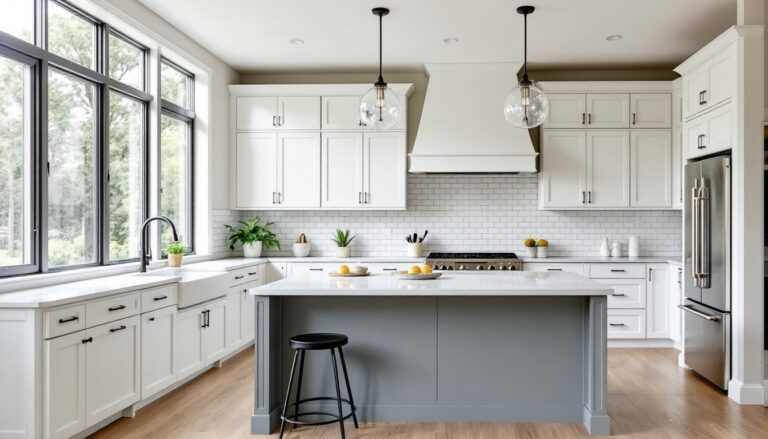
White cabinets remain a dominant choice because they deliver flexibility, brightness, and resale value. Real estate agents consistently note that white kitchens photograph well and appeal to the broadest buyer pool, making them a safe bet for homeowners planning to sell within five years.
From a design perspective, white reflects natural and artificial light, making small or poorly lit kitchens feel larger and more open. It also provides a neutral backdrop that adapts to changing hardware, countertops, and backsplash trends without requiring a full cabinet repaint.
White paint also hides minor surface imperfections better than darker colors, which tend to highlight every dent and scratch. For DIYers working with builder-grade cabinets or dated wood finishes, a quality white paint offers a cost-effective facelift that rivals the expense of replacement.
Understanding White Paint Undertones for Kitchen Cabinets
Not all whites look the same once they’re on your cabinets. Every white paint carries an undertone, a subtle hint of another color that becomes visible under different lighting conditions.
Warm whites contain yellow, beige, or pink undertones. These work well in kitchens with warm wood floors, brass or gold hardware, and south-facing windows that flood the space with warm afternoon light. They prevent the sterile, hospital-like feel that can happen with cooler whites in cozy spaces.
Cool whites lean toward blue, gray, or green undertones. They pair naturally with stainless steel appliances, chrome fixtures, and white quartz countertops. North-facing kitchens benefit from cool whites because they balance the naturally cooler light that enters those spaces.
True whites (also called pure or neutral whites) fall in the middle, with minimal detectable undertones. These are rare and tricky to identify without testing, but they offer the most flexibility across different lighting conditions.
To test undertones, paint large foam core boards (at least 2′ × 2′) with your top three choices. Move them around the kitchen throughout the day, observing how they look in morning light, afternoon sun, and under evening task lighting. What looks crisp at noon may read as dingy yellow by 7 p.m.
Top White Paint Colors for Kitchen Cabinets in 2026
Here are the standout white cabinet colors for 2026, based on durability, coverage, and how they perform under varied kitchen lighting:
Benjamin Moore Advance in Simply White (OC-117): A warm white with a slight yellow undertone that reads as soft and inviting without turning cream. Advance is a water-based alkyd formula that self-levels beautifully and cures to a hard, durable finish. Expect about 350 square feet of coverage per gallon with proper surface prep.
Sherwin-Williams Emerald Urethane in Pure White (SW 7005): A true neutral white that doesn’t skew warm or cool. The urethane formula delivers exceptional durability and resistance to moisture and grease, critical in a high-traffic kitchen. It dries fast enough to recoat in four hours under ideal conditions.
Benjamin Moore Advance in White Dove (OC-17): A soft, warm white with subtle greige undertones. It’s less stark than Simply White, making it a favorite for kitchens with natural wood accents or warmer color palettes. White Dove shows up frequently in top kitchen cabinet paint colors for its forgiving, adaptable tone.
Sherwin-Williams ProClassic in Alabaster (SW 7008): Another warm white with a hint of beige. ProClassic is available in both oil-based and acrylic formulas: the acrylic cleans up easier, but the oil-based version yields a smoother, more traditional finish if you’re willing to deal with solvent cleanup.
Farrow & Ball All White (No. 2005): A cooler white with a subtle gray undertone. It’s pricier than domestic brands but offers depth and complexity that cheaper whites lack. All White works especially well in modern kitchens with concrete or stainless finishes.
All of these perform well when applied with a foam roller (for flat surfaces) and a 2″ angled brush (for detailed areas). Avoid bargain-grade paints: kitchen cabinets endure constant handling, grease spatter, and cleaning, so invest in a product engineered for trim and cabinetry.
Choosing the Right Paint Finish for Kitchen Cabinets
Finish affects both durability and appearance. For kitchen cabinets, you’re choosing between satin, semi-gloss, and occasionally gloss.
Satin (or “eggshell” in some lines): Offers a low luster that hides minor surface imperfections and feels softer visually. It’s easier to touch up than higher sheens but less resistant to scrubbing. Satin works well in kitchens where cabinets aren’t handled constantly, think upper cabinets or butler’s pantries.
Semi-gloss: The workhorse finish for kitchen cabinets. It resists moisture, wipes clean easily, and stands up to repeated handling around pulls and knobs. Semi-gloss does highlight surface flaws, so thorough sanding and priming are non-negotiable.
Gloss: Delivers a high-shine, almost lacquer-like finish. It’s extremely durable but shows every imperfection and requires expert-level prep and application. Unless you’re going for a modern, high-contrast look, gloss is overkill for most DIY projects.
Most pros recommend semi-gloss for lower cabinets and drawer fronts (high-contact areas) and satin for uppers (lower-contact areas). This balances durability with a softer overall aesthetic.
Essential Prep Work Before Painting Kitchen Cabinets White
Prep determines success. Skipping steps here guarantees paint failure within months.
Remove doors, drawers, and hardware. Label each door with painter’s tape and a number corresponding to its location. Remove hinges and handles: paint won’t adhere properly around hardware, and you’ll get a cleaner look by painting bare surfaces.
Clean thoroughly. Years of cooking grease and grime prevent paint adhesion. Use a TSP substitute cleaner (trisodium phosphate or a phosphate-free alternative) mixed per label directions. Scrub all surfaces with a sponge, then rinse with clean water and let dry completely, at least 24 hours.
Sand everything. Use 150-grit sandpaper to scuff all surfaces. You’re not stripping the finish entirely: you’re creating texture for the primer to grip. Sand with the grain on flat areas, and use a sanding sponge for detailed profiles. Wipe away dust with a tack cloth, never a damp rag, which can raise the grain.
Fill imperfections. Use wood filler for dents and gouges. Let it cure per the label (usually 30 minutes to two hours), then sand flush with 220-grit paper.
Prime with a bonding primer. This step is non-negotiable. A quality bonding primer like Zinsser B-I-N (shellac-based) or Kilz Adhesion (water-based) seals knots, blocks tannin bleed, and gives topcoat paint a solid foundation. One coat is usually sufficient: two coats if you’re covering dark stain or red oak. Let primer dry fully, check the label, but plan on at least four hours.
Work in a well-ventilated area. If you’re using solvent-based primers or paints, wear a respirator with organic vapor cartridges, not just a dust mask. Open windows and run a box fan.
Step-by-Step Application Tips for Flawless White Cabinets
Once prep is complete, application is straightforward, but technique matters.
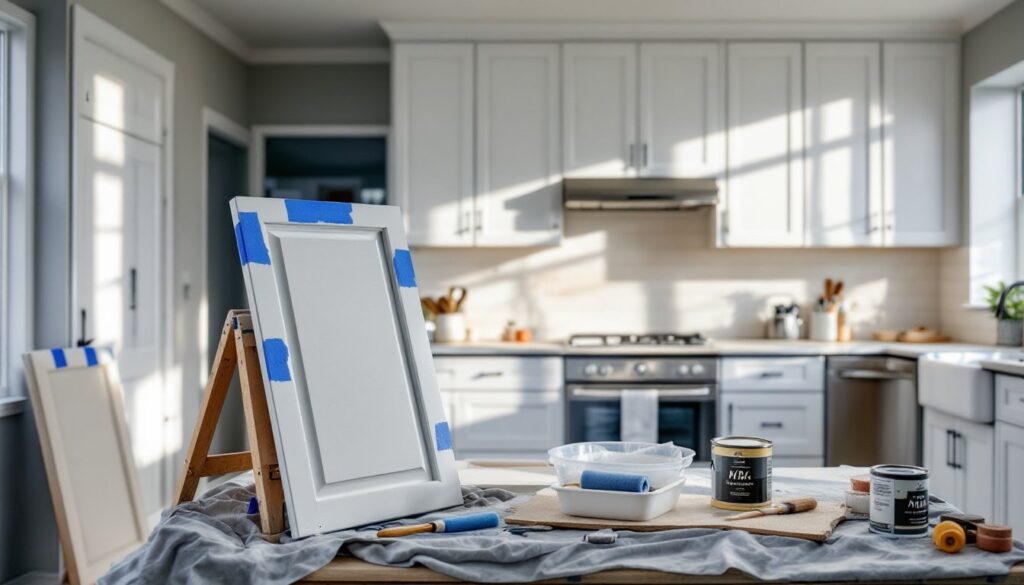
1. Set up a proper workspace. Lay cabinet doors flat on sawhorses or a sturdy table. This prevents drips and allows gravity to work with you. If space is tight, paint one side, let it dry completely, then flip and paint the other.
2. Apply thin coats. Thick coats sag, drip, and take forever to dry. Load your brush or roller lightly and spread paint evenly. For flat door panels, roll first (use a 4″ foam roller for the smoothest finish), then tip off with a dry brush to eliminate roller texture.
3. Brush detailed areas first. On raised-panel doors, paint the profiles and edges with a 2″ angled sash brush before rolling the flat center. This keeps wet edges manageable and prevents lap marks.
4. Sand between coats. After the first topcoat dries (usually four to six hours for water-based paints, overnight for oil-based), lightly sand with 220-grit paper. Wipe with a tack cloth. This step levels the surface and ensures the next coat adheres properly.
5. Plan for at least two topcoats. Some pros recommend three, especially when going from dark stain to bright white. Light colors require more coats to achieve full opacity and even coverage. Many DIYers find inspiration and tutorials on sites like Young House Love, which showcases budget-friendly cabinet makeovers.
6. Cure before reassembling. Paint may be dry to the touch in hours, but full cure takes one to two weeks. Reinstall hardware and rehang doors after at least 48 hours, but avoid slamming doors or stacking dishes on shelves for the full cure period. Designs featured on kitchen-focused sites often emphasize giving paint time to harden fully before daily use.
Safety note: Always wear nitrile gloves when handling solvents and primers. Use safety glasses when sanding overhead. If you’re spraying instead of brushing (using an HVLP sprayer for a factory-smooth finish), wear a full-face respirator and work outdoors or in a spray booth.
Tool alternatives: A paint sprayer (like a Graco or Wagner HVLP model) delivers the smoothest finish but requires practice and thorough masking. A foam roller and brush combo is the DIY standard, it’s slower but much more forgiving for first-timers.
Conclusion
Selecting the best white paint for kitchen cabinets comes down to understanding undertones, choosing a durable finish, and committing to thorough prep. Benjamin Moore Advance and Sherwin-Williams Emerald Urethane lead the pack for DIY-friendly application and long-term performance. Sand, prime, apply thin coats, and give the paint time to cure, and those white cabinets will stay crisp and clean for years.