Table of Contents
ToggleA gray kitchen with white cabinets delivers clean contrast, versatile styling options, and long-term appeal. Unlike all-white kitchens that can feel sterile or dark cabinetry that shrinks a space, the gray-and-white pairing balances warmth and brightness. It works with both modern and traditional architecture, adapts to changing hardware and lighting trends, and hides minor wear better than stark white alone. Whether planning a full remodel or a cabinet refresh, understanding how to select and combine these neutrals will help homeowners avoid common pitfalls like mismatched undertones or a washed-out look. This guide covers shade selection, layout strategies, and finish pairings to create a kitchen that feels both current and enduring.
Key Takeaways
- Gray kitchen white cabinets create visual depth and balance warmth with brightness, hiding fingerprints and minor wear better than all-white or all-dark schemes.
- Select gray with an LRV between 50–65 for walls and 30–50 for cabinetry, testing samples in both natural and artificial light to match the white cabinet undertone and avoid a dingy or cold appearance.
- A gray island with white perimeter cabinets is a popular modern design that anchors the space and defines zones without making the kitchen feel dark.
- White quartz, marble with gray veining, or butcher block countertops effectively bridge gray and white cabinetry while maintaining durability and visual cohesion.
- Match hardware finishes (matte black, brushed nickel, or brass) consistently across cabinet pulls, range hoods, and faucets to tie the gray-and-white palette together.
Why Gray and White Is the Perfect Kitchen Color Combination
Gray and white cabinets create visual depth without the stark contrast of black and white. White reflects light and keeps upper cabinets from feeling heavy, while gray grounds the space and adds dimension to islands, lower runs, or accent walls. The combination hides fingerprints and minor scuffs better than pure white, a practical advantage in high-traffic kitchens.
This pairing also offers flexibility. Homeowners can shift accessories, textiles, and small appliances without clashing, navy, brass, black stainless, or natural wood all read clearly against a gray-and-white base. It’s why designers often choose this scheme for spec homes and rentals: it appeals to a wide range of tastes without feeling generic.
From a resale perspective, gray and white read as updated but not trendy. Buyers recognize the palette as current without worrying it’ll look dated in three years, unlike bolder color commitments. The combination also photographs well, which matters for online listings.
Finally, gray provides visual weight that all-white kitchets sometimes lack. It defines zones, like separating an island from perimeter cabinets, without introducing high-contrast color that can dominate a layout. Many kitchen design ideas leverage this subtle zoning to make open-plan spaces feel organized.
Choosing the Right Shade of Gray for Your Kitchen
Not all grays work with white cabinets. The wrong undertone can make white look dingy or create a cold, institutional feel. Test paint samples on at least two walls, one that gets morning light and one that stays shaded, and view them at different times of day. Gray shifts dramatically under warm incandescent bulbs versus cool LED strips.
Stick to grays with an LRV (Light Reflectance Value) between 50 and 65 for walls. Higher LRVs keep the kitchen bright: lower values can make a small kitchen feel closed in. For cabinetry, grays in the 30–50 LRV range provide contrast without going too dark. If the kitchen has limited natural light, push toward the lighter end of the spectrum.
Consider the white you’re pairing. Bright whites (like Benjamin Moore Chantilly Lace or Sherwin-Williams Pure White) need cooler or true grays to avoid a yellow cast. Warmer whites (such as BM White Dove or SW Alabaster) pair better with greiges or warm grays that share a similar undertone. Sampling both colors side by side is non-negotiable, what looks balanced in a paint deck often clashes on drywall.
Warm vs. Cool Gray Tones
Cool grays have blue or green undertones and pair well with stainless steel appliances, chrome hardware, and marble or quartz with gray veining. They suit modern and transitional kitchens, especially those with north-facing windows or abundant natural light. Cool grays can feel sterile in poorly lit spaces or with warm-toned wood flooring, so test carefully.
Warm grays lean toward beige (greige) or taupe and work with brass or matte black fixtures, butcher block countertops, and wood-look tile. They’re forgiving in artificial light and complement open floor plans that flow into living areas with warm paint. Warm grays are a safer choice if the home already has oak, walnut, or hickory flooring, as they won’t fight existing wood tones.
Design Ideas for Gray Kitchens with White Cabinets
Combining gray and white offers several layout and color-blocking strategies. Each approach changes the visual weight and flow of the kitchen. Choosing the right one depends on ceiling height, natural light, and whether the space is galley, L-shaped, or open-concept.
Gray Walls with White Upper and Lower Cabinets
Painting walls gray while keeping all cabinetry white creates a cohesive, enveloping feel. It works especially well in kitchens with 9-foot or higher ceilings, where gray walls won’t shrink the space. This approach highlights white cabinets as the focal point and allows hardware, lighting, and backsplash to stand out.
Use a mid-tone gray (LRV 55–60) to avoid overpowering the cabinets. If the kitchen has a lot of upper cabinetry, gray walls prevent the “floating” look that happens when white cabinets blend into white walls. For open shelving or glass-front cabinets, gray walls provide contrast that makes dishware and glassware visible.
This layout pairs well with white subway tile backsplashes or a marble slab with gray veining. Keep the ceiling white to maintain height, and use under-cabinet lighting to prevent shadows from dulling the gray.
Gray Island with White Perimeter Cabinets
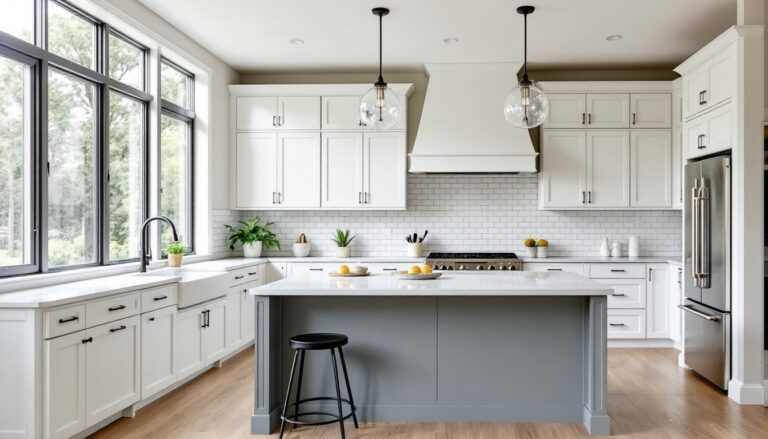
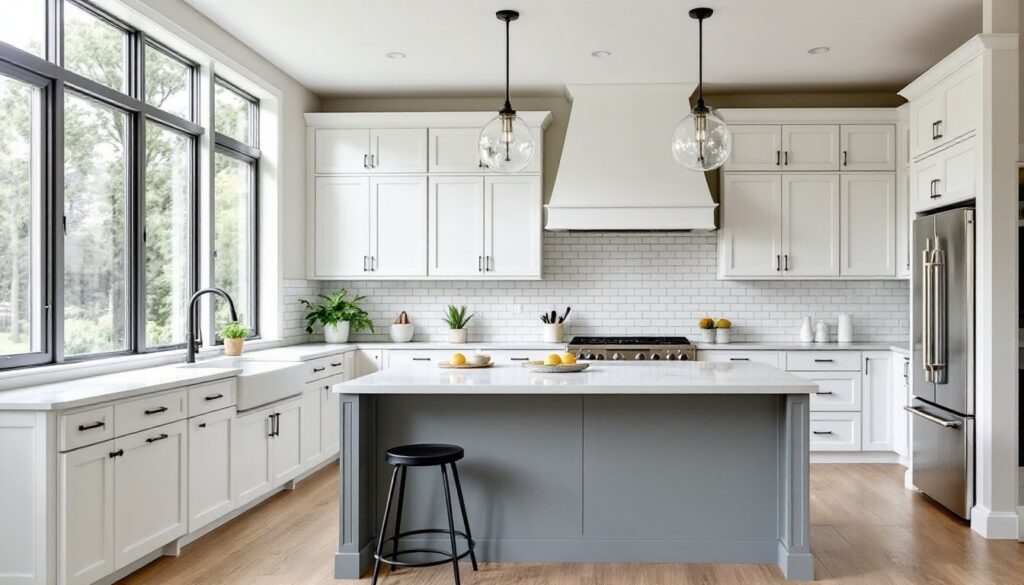
A gray island with white perimeter cabinets is one of the most popular modern grey and white kitchen cabinets configurations. It anchors the space without making the kitchen feel dark. Islands naturally draw attention, they’re where prep work, assignments, and casual meals happen, and a contrasting color defines that zone.
Choose a gray that’s at least 10–15 LRV points darker than the walls to create clear separation. For example, if walls are a soft greige at LRV 60, an island in the LRV 40–45 range will stand out without dominating. Extend the gray to the island’s side panels and toe kick for a cohesive look.
This strategy works in both large and small kitchens. In a galley or L-shaped layout without a traditional island, consider painting the lower cabinets on one wall gray and keeping uppers white. The effect is similar: grounded visual weight at counter height with brightness above.
Hardware choices matter here. Matte black or brushed nickel on the gray island, matched to the white perimeter cabinets, ties the palette together. Avoid mixing hardware finishes unless there’s a clear design reason, like a statement range hood or pot filler in a third finish.
Countertop selection becomes critical. White quartz or marble on both the island and perimeter keeps the palette light, while a contrasting butcher block or darker stone on the island adds warmth. Homeowners drawn to kitchen grey and white cabinets often choose this layout because it feels intentional without requiring a full commitment to an all-gray or all-white scheme. Several curated galleries showcase how professionals balance these elements to maintain visual interest.
Selecting Countertops and Backsplashes to Complement Your Design
Countertops and backsplashes either unify or fragment a gray-and-white kitchen. The goal is to bridge the two colors without introducing a third dominant hue that competes for attention. Material choice also affects durability, maintenance, and cost, factors that matter as much as aesthetics in a working kitchen.
White quartz (like Caesarstone Pure White or Cambria Torquay) is the most forgiving countertop for gray and white cabinets. It ties the palette together, resists staining better than marble, and doesn’t require sealing. Expect to pay $60–$100 per square foot installed, depending on edge profile and regional labor rates. Quartz is non-porous, so it won’t harbor bacteria, a plus for serious home cooks.
Marble or quartzite with gray veining adds organic movement. Carrara, Calacatta, or Super White quartzite all feature gray or charcoal veins that echo gray cabinetry. Marble requires annual sealing and is vulnerable to acidic spills (lemon juice, wine, vinegar), so it’s better suited to a low-use island than a prep-heavy perimeter. Quartzite is harder and more stain-resistant but costs $80–$150 per square foot.
Butcher block or wood countertops introduce warmth that prevents gray and white from feeling clinical. Maple, walnut, or oak work well on an island, especially if paired with white quartz on the perimeter. Wood requires oiling every few months and isn’t heat- or water-resistant, so it’s best reserved for serving or light prep areas.
For backsplashes, white subway tile (3″×6″) is the default for a reason: it’s clean, affordable ($5–$12 per square foot for materials), and timeless. Use a light gray grout (Mapei Silverado or Pewter) to tie in gray elements without the maintenance headaches of white grout. Stack bond or herringbone patterns add visual interest without introducing new colors.
Gray or white mosaic tile works in smaller doses, behind the range or as a feature band. Avoid overly busy patterns that compete with cabinetry: the tile should recede, not dominate. If the kitchen already has a gray island and gray walls, a white backsplash prevents visual overload.
Slab backsplashes (marble, quartz, or porcelain) create a seamless, modern look and eliminate grout lines. They’re pricier, figure $40–$80 per square foot installed, but reduce cleaning time and work well in contemporary kitchens with minimal upper cabinets. Match the slab to the countertop for continuity, or choose a complementary stone with subtle veining.
Hardware and fixtures are the final bridge. Polished chrome or brushed nickel skews cool and pairs with blue-gray tones, while matte black, oil-rubbed bronze, or unlacquered brass warms up greige or taupe-gray schemes. Consistency matters: if the range hood, faucet, and cabinet pulls are matte black, the lighting should follow suit. Mixing metal finishes is possible but requires a confident eye and a unifying element, like a black range or brass pot filler, to anchor the choices.